Gisela Peters · 2 September 2026
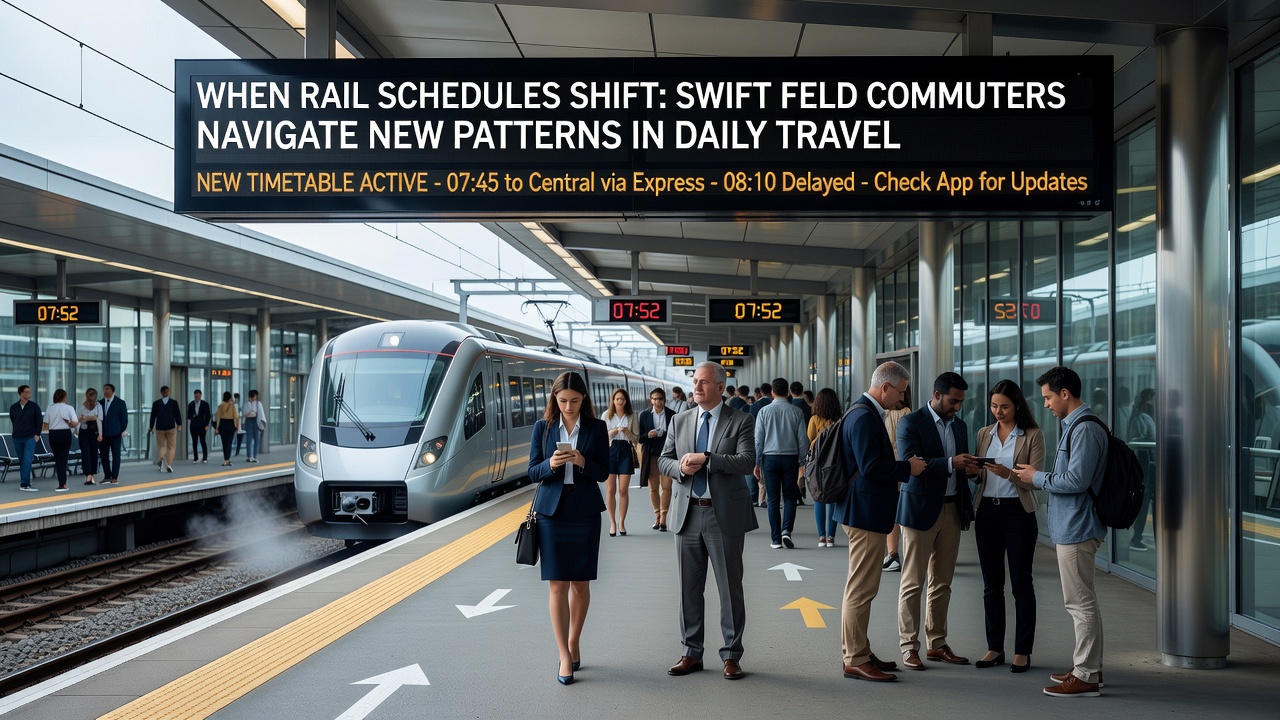
When Rail Schedules Shift: Swiftfeld Commuters Navigate New Patterns in Daily Travel
Swiftfeld commuters encounter revised rail timetables that take effect in September 2026, and these modifications alter departure times across multiple lines serving the region while prompting adjustments in work start times and connection planning. Local rail operators implement the updates to accommodate track maintenance projects and capacity increases on high-demand routes, which results in earlier or later services depending on the line and direction of travel.
Details of the Timetable Revisions
Trains on the Swiftfeld to regional hub line now depart at intervals that differ from previous patterns, with morning peak services shifted by up to fifteen minutes in some cases, and evening returns adjusted accordingly to maintain overall service frequency. Data from operator records indicate that these changes affect approximately 12,000 daily passengers who rely on connections through Swiftfeld station, and similar adjustments appear on secondary routes that link smaller districts to the main network.
Officials coordinate the rollout with neighboring transport authorities so that bus feeders align with new arrival times, although some gaps remain during the initial transition period. Those who studied prior schedule overhauls note that full stabilization often requires several weeks as riders test alternative options and refine their routines.
Factors Driving the Adjustments
Track renewal work between Swiftfeld and the next major junction necessitates single-track operations during daytime hours, which forces operators to compress schedules and redistribute train paths across the available infrastructure. European Union Agency for Railways documentation outlines how such maintenance cycles occur every five to seven years on busy corridors, and the current phase incorporates upgrades that support higher speeds once complete.
Passenger growth statistics compiled by regional authorities show a 9 percent rise in rail usage since 2023, and planners cite this trend as justification for reallocating rolling stock to accommodate demand without expanding the fleet immediately. The combination of infrastructure needs and ridership pressure produces the September 2026 window chosen for implementation.
Effects on Commuter Routines
Workers who previously caught the 6:47 service now board at 7:02, which compresses preparation time at home and alters school drop-off arrangements for families that share vehicles before reaching the station. Evening commuters experience corresponding delays on return journeys, leading some employers to offer flexible start windows that range from 15 to 30 minutes to reduce missed connections.

Parking demand at Swiftfeld station rises during the first month as individuals who once walked from nearby stops drive instead to catch earlier buses, and local traffic counts record a temporary 6 percent increase on approach roads. Alternative routes via neighboring stations become more common, although those options add between 12 and 25 minutes to total journey duration according to journey-planning applications used by residents.
Adaptation Strategies Observed
Community forums document shared rides among colleagues who align their new departure times, and several employers establish internal carpool registries to support staff affected by the changes. Cycling infrastructure sees increased use on routes under 8 kilometers, with bike storage at Swiftfeld station reaching 85 percent capacity during weekday mornings within the first two weeks of the new schedule.
Real-time apps receive updates that incorporate the revised timetable, and transport planners encourage users to set alerts 24 hours in advance so that last-minute platform changes appear promptly. A study published by the University of Stuttgart on commuter resilience examined similar timetable shifts in comparable mid-sized towns and found that most travelers establish stable new patterns within four to six weeks when clear information channels exist.
Available Data and Broader Context
Passenger surveys conducted by the regional transport association collect responses from over 2,400 individuals during the initial rollout phase, and preliminary results indicate that 68 percent report successful adaptation while 22 percent continue to seek further adjustments. On-time performance metrics released by the operator show a slight dip to 91 percent in the first fortnight before recovering toward the 94 percent average recorded in the prior quarter.
Connections with long-distance services remain intact at the main interchange points, although some travelers now allow additional buffer time between regional and intercity legs. Observers note that the September 2026 implementation coincides with the start of the academic year, which adds student commuters to the mix and increases pressure on peak-hour capacity.
Conclusion
Rail schedule revisions in Swiftfeld reshape daily travel patterns for thousands of residents through coordinated timetable updates, infrastructure maintenance, and passenger growth pressures that converge in September 2026. Commuters respond with revised departure routines, shared transport arrangements, and greater reliance on real-time information tools while operators monitor performance metrics and survey feedback to refine ongoing support measures. The process illustrates how regional rail networks balance maintenance requirements against service reliability when usage continues to rise.